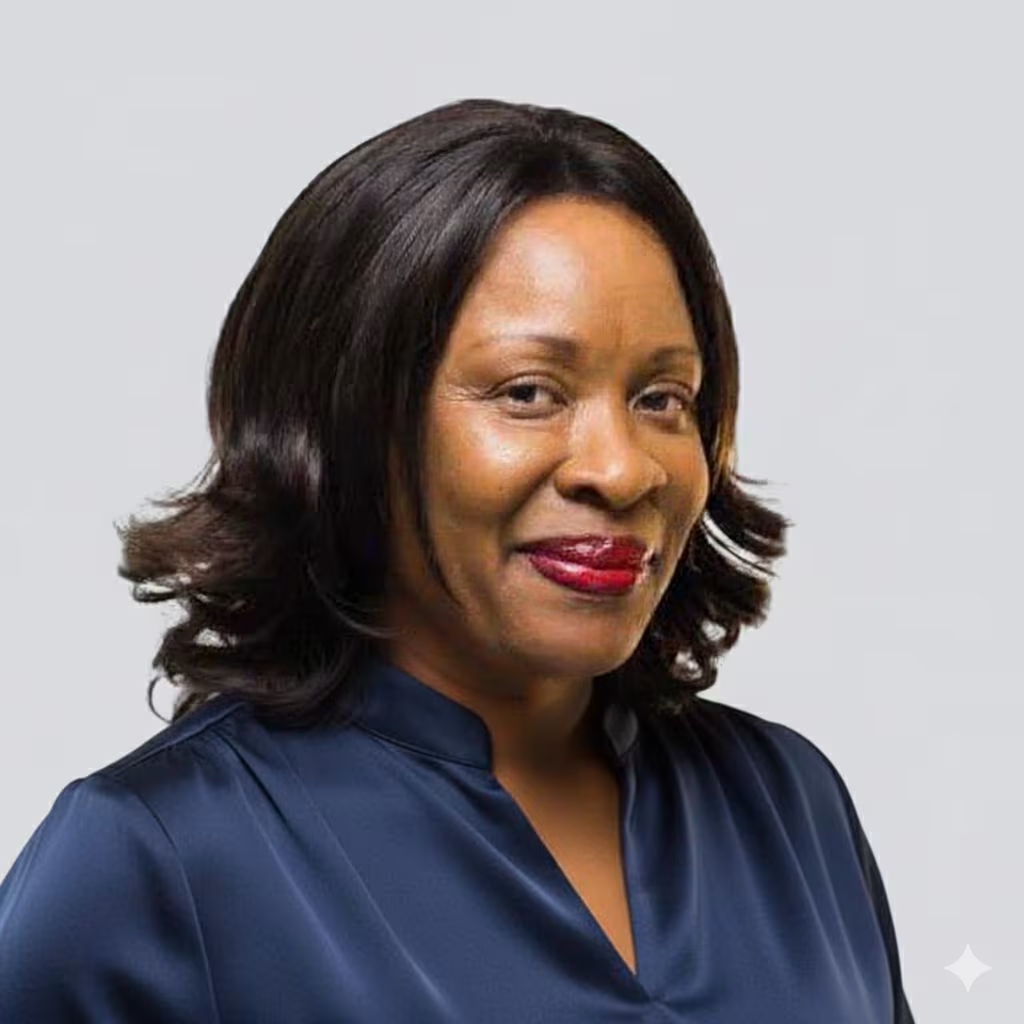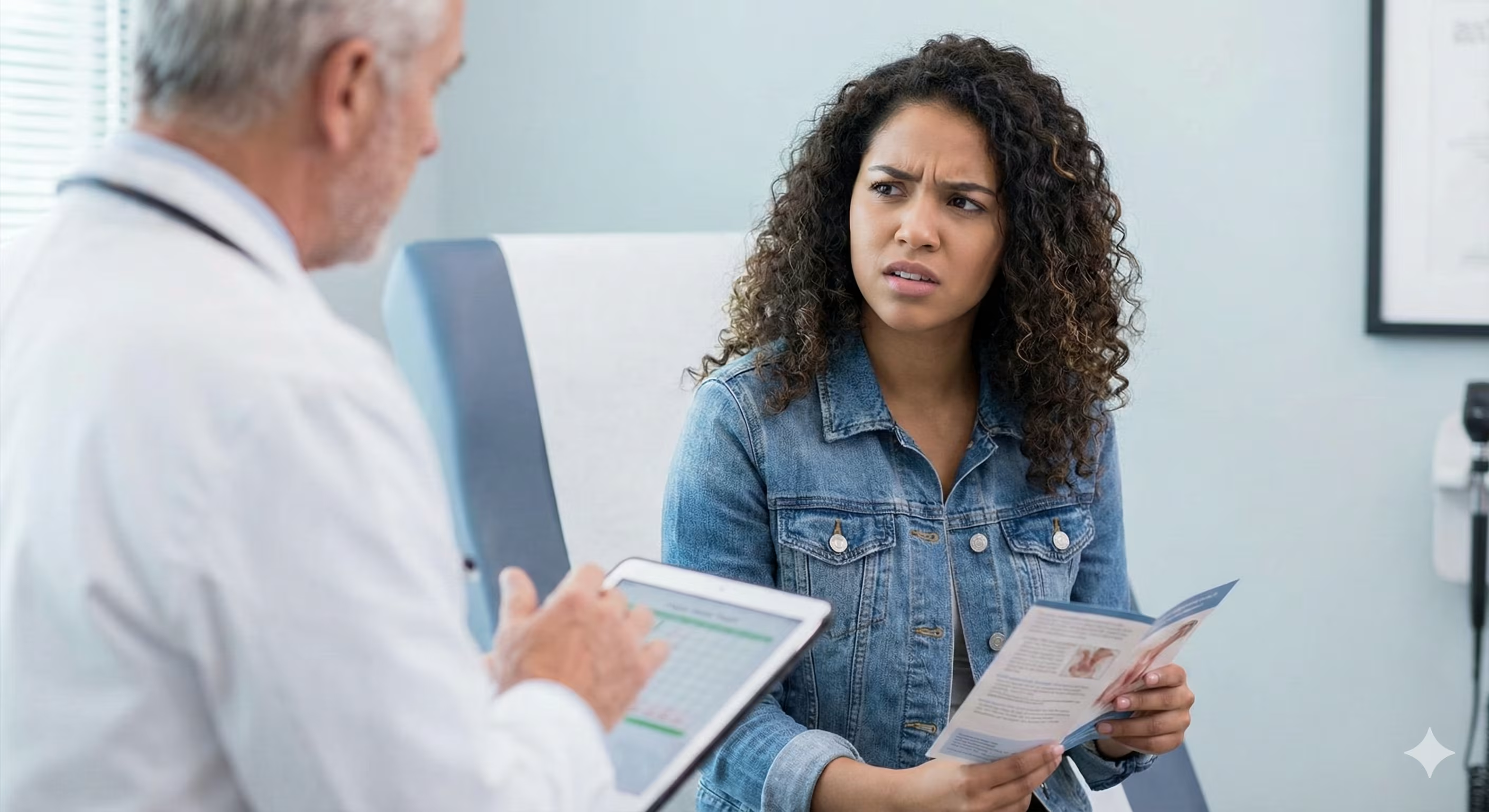
You're educated. You have insurance. You have a job, a career, and you've handled harder things than this.
So why is finding good perimenopause care feeling impossible?
According to new research from Black Women's Health Imperative (BWHI), you're not alone in this struggle. Even among Black women who are well-resourced, insured, and highly educated, there is a profound gap between what women need and what healthcare actually provides.
Let's talk about what's really happening and what you can do about it.
The Research: What 1,547 Black Women Actually Said
In 2025, Black Women's Health Imperative conducted the largest cross-sectional online survey of US-based Black women ages 30 and older to understand their experiences with menopause. The results are striking.
The women who participated represent the women you likely know. They are:
• Majority college educated with 33 percent holding graduate degrees• 96 percent with health insurance• 78 percent employed, with 67 percent working full time• Over half earning $75,000 or more annually• 54 percent living in the South• 46 percent married, 21 percent single, 16 percent divorced
In other words, these are accomplished, resourced, insured Black women with strong earning power and access to care.
And they are still struggling to find good perimenopause care.
The Knowledge Gap: What We're Not Being Told
Here's where the problem begins.
54 percent of respondents said they did not have enough information to manage their symptoms effectively.
52 percent reported they didn't know which recommendations to follow.
Many women only associated menopause with hot flashes. They had no idea that perimenopause could bring brain fog, joint pain, weight gain, depression, hair thinning, and digestive problems.
One woman shared: "I literally only heard of one symptom which was hot flashes. The brain fog and low energy is the absolute worst thing. I truly thought that I was going into early Alzheimer's."
Another said: "I did not realize all of the other symptoms associated with menopause like joint pain, hair thinning, digestive issues. All of which I have."
Think about that for a moment. These are educated women. They have access to information. They have healthcare. And they still didn't know what was happening to their bodies.
This isn't a knowledge problem that Google can fix. This is a systemic failure to prepare Black women for what perimenopause actually looks like.
The Symptom Reality: What's Actually Making Life Hard
The survey identified what women are really struggling with. And it's not what healthcare providers typically focus on.
Brain fog, night sweats, and fatigue were described as more disruptive than hot flashes.
55 percent struggled with weight gain.
42 percent struggled with depression.
Women reported experiencing symptoms for 9 or more years. That's far longer than many expect.
One woman said: "There should be more information readily available about the impact perimenopause has on mental health. The rage and anxiety are so scary."
Another shared: "I wish more was said in my 30s about perimenopause. I wish I had better access to healthcare I could trust."
These aren't minor inconveniences. These are life altering symptoms that persist for nearly a decade. And most women go through them without adequate preparation or support.
The Healthcare Barrier: What Happens When You Try to Get Help
Here's where the research gets painful.
43 percent of respondents reported being discriminated against or treated unfairly when seeking healthcare.
In qualitative responses, many women described instances where clinicians minimized or ignored their menopause concerns. They felt dismissed and unsupported.
One woman said: "When I brought up menopause with a Caucasian OB/GYN, she told me I was too young. I am African American, 47 years old, with a history of a hysterectomy."
Another: "Ignored by my doctor. I'm just miserable going through this."
This is medical gaslighting happening in real time. And it's not happening by accident. It's the intersection of two well documented realities:
First, Black women experience perimenopause symptoms earlier and more severely than white women. And yet our symptoms are taken less seriously.
Second, the healthcare system is not built to see us or believe us. Studies consistently show that Black women's pain is perceived as less intense, our symptoms are dismissed more often, and our healthcare concerns are taken less seriously than white women's concerns.
When you combine these realities, you get what's happening in these exam rooms: educated, insured Black women with serious symptoms being told they're too young, that it's not that bad, or that they need to just manage it on their own.
What Women Are Actually Asking For
Black Women's Health Imperative asked: What do you need?
66 percent expressed a need for greater culturally grounded education beginning in their 30s.
Through qualitative feedback, many women said they are seeking:
• More affordable treatment options• Better access to trusted providers• Safe spaces to share their experiences• Reduced stigma surrounding menopause
Notice what women did not ask for: sympathy, or tips on how to "power through," or encouragement to just be open about it.
What they asked for was education, access, trust, and community.
How To Find Good Care: What You Actually Need To Know
Based on what this research reveals, here's what matters when you're looking for perimenopause care.
1. Start in Your 30s, Not Your 40s or 50s
Perimenopause can start in your 30s. You need to know this. You need baseline understanding before symptoms escalate. Find a provider who will talk with you about perimenopause as a life stage, not as a crisis that only matters once you're in the thick of it.
2. Find a Provider Who Understands Black Women's Experiences
You need a provider who:
• Knows that Black women experience perimenopause symptoms earlier and more severely• Understands medical racism and how it impacts care• Takes your symptoms seriously without requiring excessive proof• Doesn't tell you you're "too young" when you're clearly experiencing something
This might be a Black woman provider. It might not be. But it needs to be someone who is explicitly aware of racial health disparities and is actively working to address them in their practice.
Ask directly: "How do you approach menopause care for Black women? What do you know about how our symptoms differ?"
If they look confused, move on.
3. You Need Information About All Perimenopause Symptoms, Not Just Hot Flashes
A good provider will talk with you about brain fog, sleep disruption, mood changes, weight gain, joint pain, and digestive changes. They'll help you understand which symptoms are perimenopause and which might be something else entirely.
Ask: "What are the less obvious symptoms I should be watching for?"
A good provider will have an answer.
4. You Need Treatment Options, Not Just Reassurance
"Just wait it out" is not a treatment plan.
You need a provider who can discuss:
• Hormone replacement therapy (if appropriate for you)• Lifestyle modifications that actually work• Mental health support for mood changes• Medications for specific symptoms if needed• Alternative treatments if HRT isn't right for you
More importantly, you need options. Not one path. Options.
5. You Need a Provider Who Charges Fairly and Takes Your Insurance
The survey was clear: women want "more affordable treatment options."
You should not have to choose between financial security and good perimenopause care. If a provider is charging extremely high out-of-pocket costs, find another one. There are options that work with insurance.
What This Research Really Means
According to Ifeoma C. Udoh, Ph.D, EVP of Policy and Research at BWHI: "What this study reveals is that education and access alone are not enough. Even among Black women who are well-resourced, insured, and highly educated, there is still a lack of information and guidance around menopause. That gap speaks to a deeper disconnect in how information is shared, how care is delivered, and whose experiences are centered. We have to do more to make sure Black women are seen, heard, and supported through this stage of life."
This is the key insight: The problem isn't that Black women don't have access to healthcare. The problem is that the healthcare we have access to wasn't built with us in mind.
So finding good perimenopause care means finding someone who is actively working to bridge that gap. Someone who understands your reality. Someone who believes you. Someone who knows this is serious and treats it that way.
The Bottom Line
You don't have to figure this out alone. You don't have to accept dismissal from providers. You don't have to pretend it's not as bad as it is.
The research is clear: educated, insured, accomplished Black women like you are struggling to find good perimenopause care because the system was not built with your experiences in mind.
But that gap is becoming visible. More research is happening. More providers are waking up to what they've been missing.
And more women like you are demanding better.
Start by finding a provider who takes your concerns seriously. Then build from there. Connect with other women navigating the same thing. Get the information you need. Get the treatment options you deserve.
Your perimenopause matters. Your health matters. And you deserve care that reflects that.
About This Article
This article is based on the 2025 Black Women's Health Imperative survey "Exploring the Lived Experiences of Black Women During the Menopausal Transition."
The survey included 2,251 eligible respondents, of which 1,547 identified themselves as Black women ages 30 and older. The mixed-methods analysis included quantitative data and qualitative responses.
Black Women's Health Imperative (BWHI) is the only national nonprofit dedicated to solving the most critical health issues that Black women and girls face through innovative programs, transformative research, and lifesaving policies.
For the full report, visit BWHI.org